" Free State; a domain where normal laws and rules are momentarily suspended- a moderately transgressive zone where tinkering on is more important that measuring off, and improvisation takes precedence over permits."
-Parasite Paradise
What part of the city is undefined? In Providence, I rarely wonder if a swath of land is actively spoken for. Everything seems to be claimed and well- formed. Banks have their own strip of sidewalk to sweep, houses have a miniature ecosystem of local plant varieties that neatly meets the next door neighbor's own creation, parks are edged and carefully mowed, and median strips are raised and defined with paving complete with strategic plantings. With buildings abutted, streets squared off through a sprawl of tightly bound residences, it's hard to find a place to just wander and interact.
I come from a place where there are infinite spaces to wander; spaces that are enveloped in the natural world. This is not to say that I seek natural beauty, but rather the unpolished qualities that are inherent in nature. In Providence, I find myself attracted to those few zones where space seems undefined: alleys, abandoned lots, vine-choked interstitial spaces, and particularly the water's edge. Here, there seems to be a confused relationship between the water and the city. Where once Providence had a thriving port life, now there is dominance of industrial real estate along the water but not many places for recreation or access. There is an invisible wall between citizen and the wellspring that is the bay. Initiatives are in the works to create a new relationship between the city and the bay, many of which I understand to have commercial interests. These initiatives raise questions about how the waterfront should be developed, and for whom.
Gijs Van Oenen wrote in "The Art of Unsettling" about the hyper-planning movement in the Netherlands in 2003. He called this movement the PPP, or the `empire of Public Private Planning.' All remaining small undefined lots were targeted for urban planning and development at that time. He referred to `small unruly pockets of land still stubbornly resisting colonization by the planning culture.' These were the places that interested him. His discussion intrigued me, not only because the Parasite Paradise is about 'temporary architecture and flexible urbanism,' but because he discussed the Free State.
" That is the true spirit of the free state: a place without civil servants, where you are free to drop dead unsupervised- undisturbed yes, but also uninsured and uncared for. Not everyone is cut out for this kind of freedom." -Gijs Van Oenen
But the author points out that the phrase `free state' has two components. The one we usually focus on is `free', and it conjures visions of a visionary few wielding lofty but clumsy ideals on a small ocean island somewhere. But what of the 'state' in free state? Like any other, the free state has `rules, borders, and means of enforcing order.' A state is a state is a state. The allure of this concept for temporary architecture is the potential and meaning of unplanned spaces, and how they function to meet the needs of society. Could abandoned, undefined spaces defy traditional planning and be seen as an opportunity for interaction and play?
Where can we play?
"How can we voice the feeling that these final indigestible remains of Dutch soil are of vital importance for the political, cultural, and social metabolism of a Netherlands otherwise planned to capacity?"-Gijs Van Oenen
No doubt the dynamics Oenen is speaking of are vastly different than the dynamics of Providence, but I can't help but wonder if he isn't on to something more universal. His idea: "... to take those domains yet to be appropriated and have them temporarily function as free territory. We should take the word `function' literally, as it is less a question of establishing than of inciting, of having something happen, of setting the pace instead of pinning in place." He is talking about laboratories of creation. And when I read the word `inciting', I knew I was reading something familiar. How can we temporarily occupy currently abandoned spaces in a way that incites discussion and `sets the pace' for new thought?
Not establishing, but inciting.
Not pinning in place, but setting the pace.
The design of unplanned space?
Wednesday, February 2, 2011


Thursday, January 27, 2011
Temporarily Beautiful
"It (Beauty) creates, without itself fulfilling, the aspiration for enduring certitude. It comes to us, with no work of our own; then leaves us prepared to undergo a giant labor." - Elaine Scarry
Beauty, or the discussion of it, is Pandora's Box. In art school, as in architecture school, beauty-as an idea- is the silent body in the room that generally no instructor wants to acknowledge. If acknowledged, it's labelled a pitfall and a danger, pushed aside for the more noble pursuit of truth. Beauty is too subjective. In Elaine Scarry's book "On Beauty and Being Just", she takes on the challenge of this discussion and charges us to reconsider our definition of beauty. Beauty is an inspiration that invites us to seek out truth, according to Scarry, rather than the embodiment of truth itself.
And who can deny the intense experience of beauty? Multi-sensory and seemingly Pavlovian in certainty, we have all had experiences that imprint on our being something undeniable, though we generally can't explain the source of our certainty. Reported most frequently and informally in the `natural' landscape, beauty is observed anywhere for any individual: exquisite asymmetry in a floral arrangement, the strange and haunting allure of detritus in an abandoned space, the grace of a powerful carnivore in the act of killing its prey, a gesture, a whisper, an intangible...
Why are we afraid to speak of beauty? It's possible that the word itself- too simple and overused, cheapens our experience. Beauty might be cast too wide as a net descriptive, holding everything. It may, when uttered, cause the experience to dissipate, packaging the phenomenon with the result of dulling it. We might feel unduly required to defend the weighty word once uttered. The logical next step is to define beauty. Elaine Scarry defines the qualities of beauty in four parts:
1. Beauty is sacred. Which is to say, if beauty is self-evident, then it is like truth, `clinging to an immortal sphere.'
2. Beauty is unprecedented. In any moment we recognize something to be beautiful, we are acknowledging the uniqueness of the moment, the place, the object.
3. Beauty is lifesaving. By this, Scarry refers to the life-giving, life-affirming properties of beauty-- how everything about the experience appears more vivid than what surrounds it, and that it's retraction feels like a loss of life.
4. Beauty incites deliberation. Finally, Scarry is pointing to the intense experience of beauty as the starting point for searching. When we experience beauty, we feel certain and yet we also ultimately experience errors or disappointment. "But if the person or thing outlives its own beauty--then it is sometimes not just turned away from but turned upon, as though it has enacted a betrayal." We must then decide our stance about beauty. We can't experience an 'error' and not feel the impact of the dissolution of belief.
Temporary beauty is really the temporal nature of us, as interfaces with the world. Scarry uses the example of a beautiful vase that catches our eye. The longer we look at it, she proposes, the beauty ceases. "Was the beauty of the object false, or was it real but brief?", she asks. If we redefine beauty as a sacred, unprecedented, lifesaving provocation for the search for truth, then any perceived beauty is real and is always limited by time. The vase did not fail us, however it caused us to recognize something that we must search to find the truth or meaning in.
Why discuss beauty? There is a pedagogical order in the way architects are educated. The sequence of classes corresponds to the expected sequence learning, to then influence our thesis explorations and eventually our life as designers. My dual life as an artist and then a designer has made me painfully aware that I do not naturally possess a logically sequential way of working, at least not in traditionally accepted structures.
There is a tension between `making' and `defining' that has always existed in my own practice. I believe I make from a place that is inspired by beauty-- the unacknowledged body in the room. The core of making, for me, has intangible aspects that deny a level of explanation, at least at their inception. I do not begin the process of making with a manifesto as much as I would like to. There is not a concise thesis, no rehearsed argument, and no bullet points of reasoning. For some time, these processes have existed separately. Because of this duality, beauty and the origin of making are often pushed aside in order to complete an order of operations.
There is a statement of intent, residing consciously, objectively, and separately from the act of making. A manifesto so articulated that it's hard to imagine a bridge that will mediate the two phenomena: Making and Defining. My intent (To explore the potential of temporary architectural installations on identified sites; a juxtaposition that poses questions about the nature of site, the role of architecture, and the use of constructs as a social tool) has a hidden agenda. An inarticulate one. It is akin to beauty, in close proximity to the temporal, and is all about making for the sake of making.
Monday, January 17, 2011
What does David Byrne have to do with temporary architecture?

I've always admired the subtle genius of the song `Nothing But Flowers' by the Talking Heads. It has, in my own personal interpretation, a post-apocalyptic ambivalence toward nature commandeering the remnants of industrial society. In a time when we work so hard to resurrect a healthy balance between ourselves and nature's suppressed ecological systems, Byrne created a funny sort of 'ode to the excesses,' and also to the architecture we surround ourselves with. Or was he being sarcastic? That's the beauty of the song, I suppose.
Why is this relevant?
All things decay over time. The speed with which nature can reclaim a man-made space is surprisingly swift, when left to its own devices. It wasn't that long ago, relatively speaking, that European settlers crawled west across North America, making plans to develop everything in sight. The Jeffersonian grid, part of the Land Ordinance of 1785, was an attempt to place a visible design on untouched landscape, and organize the chaos of nature into identifiable, profitable lots.

Patterns of growth, decay, and human attempts at the organization of nature are the subjects of Byrne's commentary and are also prominent qualities of urban sites I have identified in Providence, Rhode Island. Last week, with the launching of this blog, I set out to define the `starting line' intention for my architectural thesis:
To explore the potential of temporary architectural installations on identified sites; a juxtaposition that poses questions about the nature of site, the role and definition of architecture, and the use of constructs as a tool for social change.
There are three fundamental topics in this statement:
1. What is temporary architecture?
2. What are the qualities of a potential site?
3. What/how can constructs be used to enact social change?
While looking at work such as: http://www.icebergproject.org/, http://cca-actions.org/, and others to find inspiration for engaging responses to site, I set out to identify sites (topic #2) in Providence. Sites that have- in my estimation- potential, and to talk about why I think they do. Site #1 will serve as a test example of this potential:
Site #1 Gano Street Train Tunnel & Vicinity

The East Side Railroad Tunnel was opened in 1908 and was built to replace another track at Fox Point. It originally ran two tracks, one for an electric car system and the one you see pictured above (the two photos were taken from the top of the tunnel mouth, roughly a year apart- Spring 2010 and Winter 2011)- a traditional freight train. Only 73 years later, in 1981, it was closed.
From the opening of the tunnel to the Crook Point Bascule Bridge that spans the Seekonk River, nature has aggressively reclaimed the space, with species of trees, vines, and a weed-like bamboo variety clogging the once-noisy tracks. All varieties of birds now occupy the span from the water to the tunnel's now steel-covered mouth.

The space has taken on a very pedestrian life, too. This site is on the outskirts of a residential sector and is the remnant of an industrial age. Because of it's abandonment and potential for adventure on the margins of society it attracts young people looking for a thrill (me, if I qualify as young) and displaced people looking for shelter or anonymity (me, when I want to be left alone). It is part dumping ground, part alternative recreation space, and part empty canvas. The tunnel itself- 22 feet high, 31 feet wide, and 5080 feet long- is the like the den of a sleeping dragon- full of intrigue and danger. It is so intriguing, in fact, that someone has taken a cutting torch and cut a small doorway into the thick steel cover.
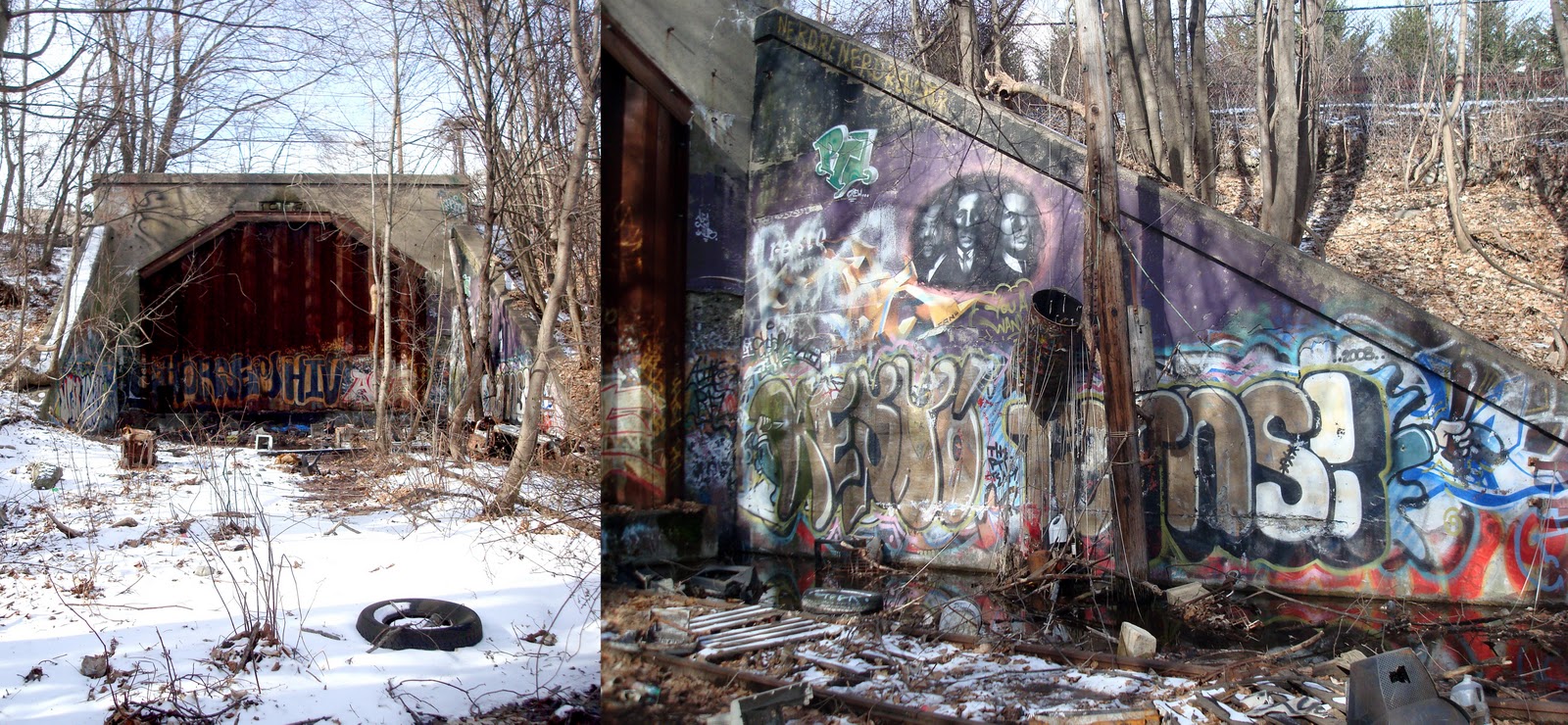
The land, still owned by the City of Providence, is a narrow strip of property leading from the tunnel to the Seekonk River. On the west side is the local grocer Eastside Market and a new condominium complex, and on the east side are neighborhood ball fields. The track sits twenty-five feet below busy Gano Street. Most cars pass over this tunnel with no knowledge of its existence but for the behemoth frozen, rusting bridge just a quarter mile away.
What is the life of this space now? What is its potential?

Site #1 provides an introduction, or character sketch, of the kind of sites I'll be working with. Each of the places listed have an element of intrigue for me, as the East Side Railway does. During three years of living and working in Providence, these places have aroused emotions leading to questions about their undefined state.
For instance, each time I drive into Providence I am conscious of the North Burial Ground. I notice its well-groomed campus with a variety of trees and memorials, and I remind myself to try and visit it before too long. But unlike Swan Point Cemetery, I resist actually visiting it because there is a conflict in my mind with it's situation along the highway. The noise, the exposure to the wind, and the lack of tranquil privacy makes me think it's the last place I would want to be buried, to place a loved one, or to visit. I'm reminded of the slow march of time and development, and wonder when the peaceful lawn of final repose became a buffer zone between the highway and a residential neighborhood. Although the North Burial Ground is not listed as one of my sites, it helped articulate those qualities that cause me to reflect each time I see it or others. Those qualities have become the foundation for my selections.
The sites are on the urban fringe.
They lack a formal identity.
They are sometimes abandoned or isolated.
They seem to simultaneously attract and repel particular human activity.
They are like a hanging question, as yet, unspoken:
Site #2 Epoch Assisted Living Shoreline

Site #3 Beneath the Henderson Bridge

Site #4 Swan Point Cemetery Meets Riverside Cemetery

Site #5 Providence Place/ Woonasquatucket River Passage West

Site #6 Highway Island/ Dean Street, Routes 6 & 10

What is temporary architecture?
What are the qualities of a potential site?
What/how can constructs be used to enact social change?
I march on to the beat of these questions and a few of David Byrne's as well~
Saturday, January 8, 2011
temporary + architecture + blog = ?
| Main Entry: | pro tempore |
| Part of Speech: | adjective, adverb |
| Definition: | for the time being |
A tent?

An emergency shelter?

A giant inflatable bubble?

Perhaps temporary architecture is an awning, a lean-to, a yurt, an umbrella, an elaborate technological showpiece for the World Expo, an Airstream trailer, or a houseboat? Could it be a gallery exhibition, an exterior installation, a covering, a container, a support, or simply a provocation?
How do temporary + architecture meet, when traditional notions of architecture imply permanence and the term temporary is a common descriptive for installation art, the two divided into their respective corners of a vast arena? What is the potential for temporary architecture as a provocation for change?
Me: A freshly birthed blogger with a tenuous toe in the expansive sea of bloggers.
My intention: to seek answers to a few of these questions and pose many, many more.
With a natural inclination to paint, draw, make, dream, and build shelters in the woods, I'm also a grad student on the [glorious] [terrifying] precipice of my graduate thesis in architecture. These pages are meant to serve as a tool- to define, map, inspire, catalog, invite, realize, and nudge -my graduate thesis into a living, breathing body of insightful design inquiries and solutions: a body of work that reflects my values as a designer and a human being. But it's not that serious, really.
Subscribe to:
Posts (Atom)